Most lenders will like to see a credit score of 750 or above to provide you the best rates on personal loans. However, some NBFCs and digital lenders also offer loans at higher interest rates or with tougher terms to customers with scores as low as 650-700.
Applying for a personal loan can feel stressful, especially when you're not sure whether your credit score will pass the test.
The truth is, your credit score is one of the biggest factors lenders check before approving your loan application.
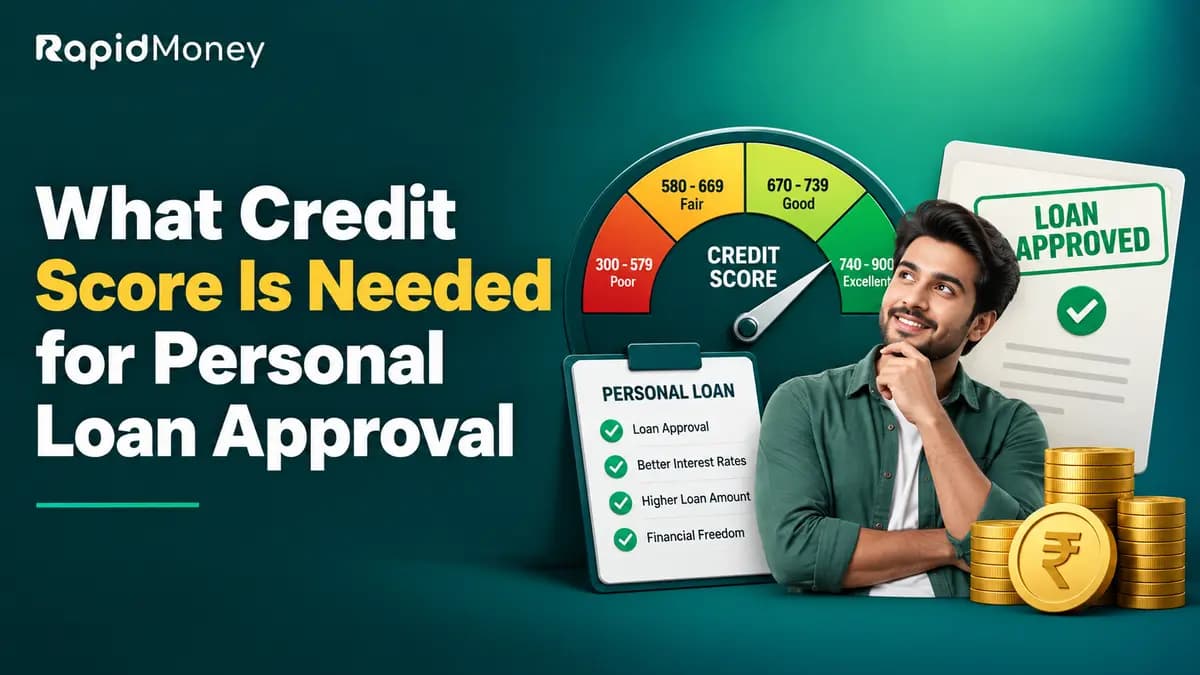
What is the credit score required for a personal loan in 2026? As a general rule, you want to be above 750 for the safest zone to get quick approval and low interest rates. Scores in the 650-749 range can still work but you may have to cope with increased charges or other restrictions.
In this guide, we look at the exact score ranges, what lenders actually look at, how to improve a weak score and what to do if you're rejected. Let’s get into it.
A credit score tells lenders how reliably you've handled borrowed money in the past.
Since personal loans are unsecured — meaning there's no collateral backing them — lenders rely heavily on your score to judge repayment risk.
A higher score signals lower risk. As a result, you get faster approval, lower interest rates, and higher loan amounts.
A lower score signals higher risk. Lenders may reject your application outright or approve it with strict conditions.
Also Read|Documents required for personal loan›
There’s no common figure, since each lender has its own cutoff. But here’s a realistic breakdown, based on normal lending procedures.
| Credit Score Range | Approval Likelihood | Interest Rate Impact |
|---|---|---|
| 750–900 | Very High | Lowest available rates |
| 700–749 | High | Slightly higher rates |
| 650–699 | Moderate | Higher rates, may need co-applicant |
| 600–649 | Low | Limited lenders, high rates |
| Below 600 | Very Low | Mostly rejected by banks; NBFCs may consider |
Most traditional banks prefer applicants with a score of 750 and above. Digital lenders and NBFCs, on the other hand, often work with slightly relaxed criteria, sometimes accepting scores around 650–700.
Knowing where your score fits in helps you set realistic expectations when you apply.
Important Note: Credit agencies may have somewhat different score bands, but the concept is the same for all major bureaus.
| Download Rapidmoney : |

|
Your credit score is important, but it’s not the only thing. Lenders also take into account:
Expert Tip: Lenders often look at your last 24–36 months of repayment behavior more closely than your overall score history.
If your score isn't where you'd like it to be, don't panic. Small, consistent actions can move the needle within a few months.
Also Read|How to Improve Cibil Score before applying for personal loan›
If your score falls below the ideal range, you still have options.
Important Note: Repeated loan applications within a short span can further lower your score, since each hard inquiry leaves a mark. Space out your applications.
So, what credit score is needed for personal loan approval? In most circumstances, a score of 750 or over provides you the best hope at speedy approval and inexpensive interest rates, however scores between 650–749 may still work depending on the lender.
Your score is not the only factor, but it is one of the most important. Knowing where you stand and doing some proactive work — like minimising credit utilisation and paying bills on time — can help you boost your approval probability dramatically.
| Download Rapidmoney : |
|
Most banks want a minimum score of 700-750 for the acceptance of a personal loan. However, certain NBFCs and digital lenders may be willing to give loans even for as low as 650 scores but usually at higher interest rates and stricter terms.
It's possible but difficult. Traditional banks usually reject applicants below 650. However, certain NBFCs, fintech lenders, or secured loan options may still consider you, often at higher interest rates.
Most customers experience a noticeable improvement between 3 - 6 months of consistent on-time payments and decreasing credit utilization. But it can take a year of disciplined credit conduct to see major changes.
Yes, a 750 credit score is a very strong score and will make you eligible to get competitive interest rates, faster processing and greater loan amounts from most banks and NBFCs.
No. When lenders look at you for a personal loan, they don’t just look at your credit score. They also look at your income, job stability, previous debt and repayment history.
It’s a good idea to check your credit score at least once every 3 months and definitely 30 days before applying for a personal loan so you can notice and repair any problems.
Yes, low or no credit history might make it difficult to get approved because lenders have no repayment history to determine risk. In such instances, a co-applicant or secured credit product might help build the credit history.