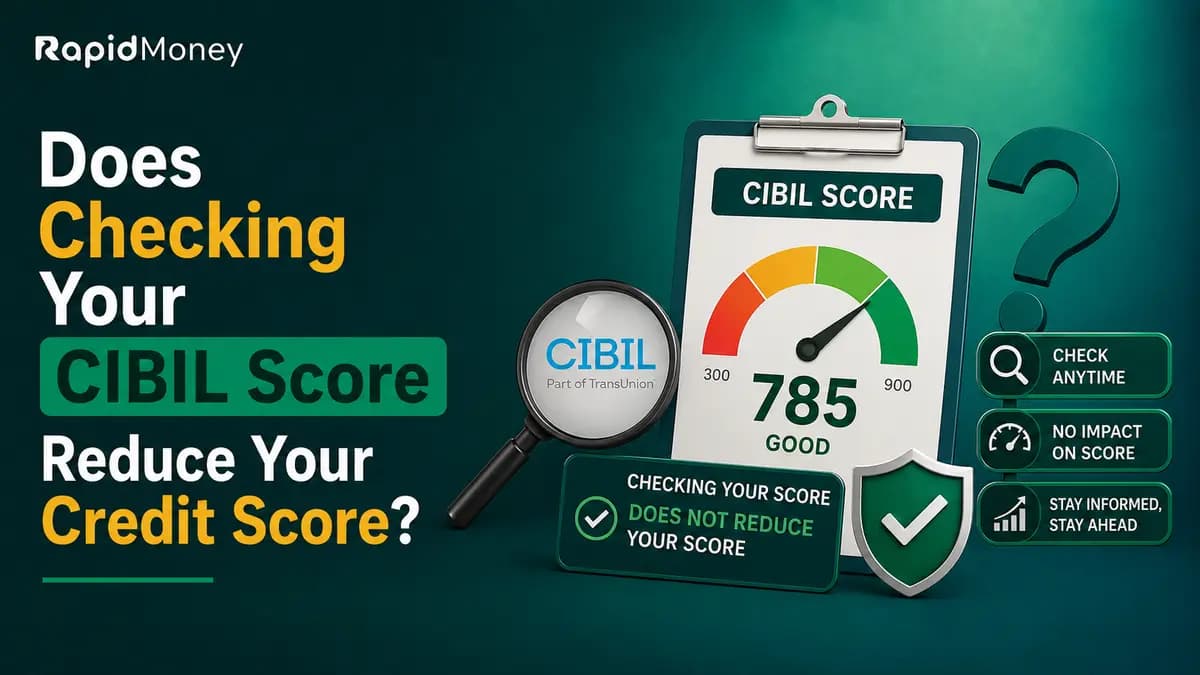
No, checking your own CIBIL Score generally does not reduce it. This is typically treated as a soft inquiry. However, when a lender checks your credit report as part of a loan or credit application, it may count as a hard inquiry and can affect your score. The impact can vary depending on your credit profile and circumstances.
You're about to apply for a personal loan, so you log in to check your CIBIL score first. Then a nagging thought hits you: will checking your own credit score reduce it?
This worry stops a lot of people from monitoring their financial health regularly. It shouldn't.
Does checking your CIBIL score reduce your credit score? The short answer is no. Understanding why requires knowing the difference between how you check your score and how a bank checks it. Then the misconception is totally busted and you may begin to be confident in watching your credit health in 2026.
Your CIBIL score is a 3 digit number which tells you how creditworthy you are. It ranges between 300 to 900. Banks and NBFCs use it to assess whether to give you a loan or credit card and at what rate of interest.
A higher score generally means faster approvals, better interest rates, and higher credit limits. That's exactly why so many borrowers want to check theirs before applying for anything.
The score is calculated using four main factors:
That last factor is where the confusion around checking your CIBIL score usually begins.
Also Read|How to Get Personal Loan with low credit score ›
Every time your credit report is accessed, it's logged as an inquiry. But not all inquiries are treated the same way by the scoring model.
A soft inquiry is when you look up your own score, or when a bank looks at your profile for a pre-approved offer without you officially applying. Never impacts your score and not visible to other lenders.
| Feature | Soft Inquiry | Hard Inquiry |
|---|---|---|
| Who initiates it | You, or a lender for pre-approval | A lender after you apply for credit |
| Impact on score | None | Small, temporary drop (5–10 points) |
| Visible to other lenders | No | Yes |
| Common examples | Self-check, employer background check | Loan application, credit card application |
| Stays on report for | Up to 2 years (score-neutral) | Up to 2 years, affects score for ~12 months |
A hard inquiry is when you apply for loan or credit card and the lender investigates your credit record to see how risky you are. Future lenders observe this type of inquiry and it can cause a little drop.
No. When you check your own CIBIL score through the official CIBIL website or an authorised app, it is always recorded as a soft inquiry. Soft inquiries carry zero weight in the scoring formula.
Credit bureaus in India, including CIBIL, deliberately designed it this way. If checking your own score lowered it, people would stop monitoring their credit health altogether, which would work against the entire purpose of credit reporting.
Important Note: This applies whether you check through CIBIL directly, a bank's mobile app, or a RBI-regulated fintech platform. As long as the check is self-initiated, your score stays untouched.
Also Read|Does Foreclosure of Personal Loan Affect Your CIBIL Score?›
So if you've been avoiding your CIBIL score dashboard out of fear, that fear isn't backed by fact. Checking it as often as you like will not reduce your credit score.
While self-checks are harmless, certain actions genuinely do affect your score. Here's what actually moves the needle:
Pro Tip: If you're loan shopping, try to submit applications within a short 14–30 day window. Many scoring models treat this as a single inquiry for major loans like home or auto loans, minimising the impact.
There's no real downside to checking your CIBIL score frequently, so the honest answer is: as often as you find useful.
| Frequency | Best For |
|---|---|
| Monthly | Active credit builders, people planning a loan soon |
| Quarterly | Most working professionals maintaining stable credit |
| Before any major application | Everyone, to confirm eligibility and catch errors |
| Immediately after a dispute | Anyone who has flagged an inaccuracy on their report |
Important Note: Always use CIBIL's official site, a bank's own app, or an RBI-regulated NBFC platform. Avoid unverified third-party links that ask for excessive personal data, since these can expose you to fraud rather than affect your score.
Also Read|₹10,000 Loan on Aadhaar Card: Eligibility, Process & EMI ›
| Myth | Reality |
|---|---|
| Checking my own score lowers it | False. Self-checks are soft inquiries with zero impact. |
| Checking daily is risky | False. Frequency of self-checks doesn't matter at all. |
| All credit checks damage my score | False. Only hard inquiries from actual applications affect it. |
| One hard inquiry ruins my score | False. A single hard inquiry typically costs only 5–10 points. |
| Bank apps checking my score count as hard inquiries | Usually false. Most in-app score views are soft inquiries; confirm with the app's terms. |
No. Checking your own CIBIL score is a soft inquiry, and soft inquiries never affect your credit score. You can check it as often as you like without any negative impact on your creditworthiness.
A soft inquiry, in contrast, is a check of your report by you or a lender that doesn’t involve a credit application and doesn’t impact your score. When a lender pulls your report after you ask for credit, it's a hard inquiry. It can bring your score down a little bit.
Generally, a tough inquiry may drop your CIBIL score by 5 to 10 points. A substantial reduction can be caused by multiple hard inquiries in a short period of time and can also be a danger indicator to lenders.
You can check your CIBIL score daily, weekly, or monthly with absolutely no risk. Frequency of self-checks has no bearing on your score, since these checks are always classified as soft inquiries.
Most banking apps display your CIBIL score through a soft inquiry, so it won't affect your score. However, it's wise to confirm this in the app's terms, since some platforms share data with lenders who may later run hard inquiries.
A hard inquiry stays visible on your CIBIL report for up to two years, but it typically only affects your actual score for about six months to a year before its impact fades completely.
Yes, but only if it was made without your authorisation or due to fraud. In that case, you can raise a formal dispute with CIBIL, and if verified, the unauthorised inquiry will be removed from your report.
Credit bureaus want people to check their credit health so that they can spot inaccuracies and fraud early. Score computations deliberately exclude easy inquiries as penalizing self-checks would discourage this prudent behavior.
So, does checking your CIBIL score reduce your credit score? No, it doesn’t, and it never will, as long as it’s you initiating the check. Self checks are considered soft pulls and do not go toward your credit score calculation.
What genuinely affects your score are hard inquiries from loan or credit card applications, missed payments, and high credit utilisation. Understanding this difference means you can monitor your credit health confidently, without hesitation, throughout 2026 and beyond.
Examine your CIBIL score every month and examine your report for mistakes.