|
Key Takeaways
|
Managing money can feel difficult when rent, groceries, bills, shopping and other expenses compete for your salary. You may want to save more each month, but without a clear plan, it is easy to spend more than you intended.
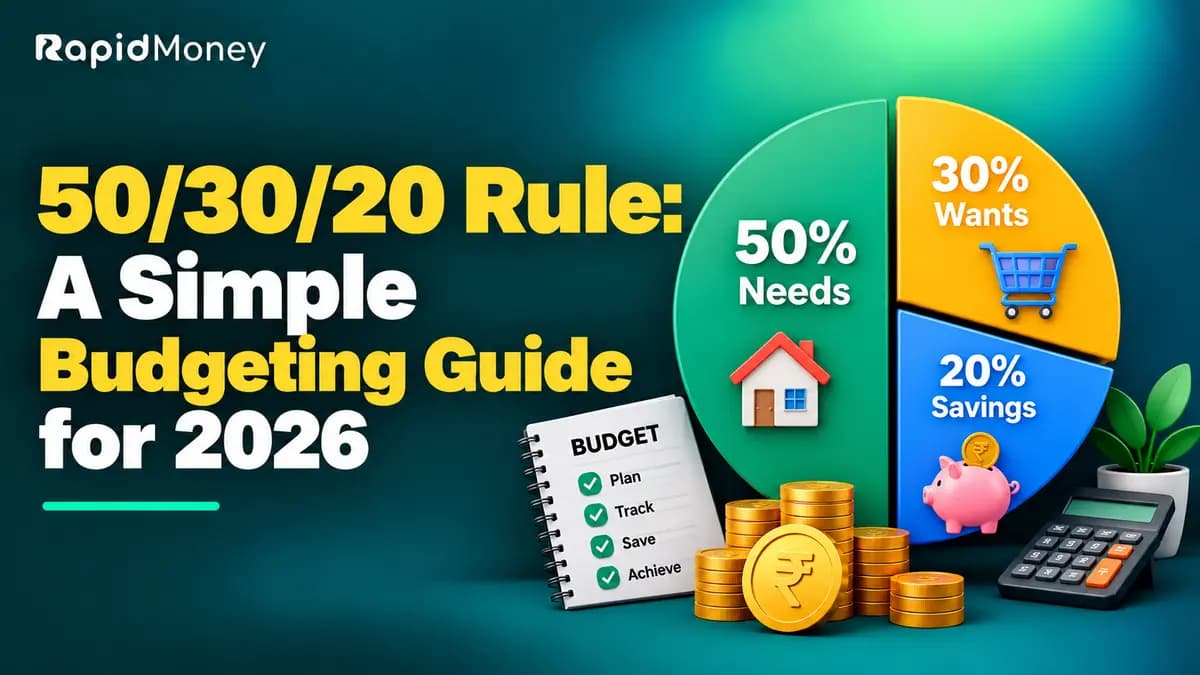
50/30/20 Rule offers a simple way to organise your monthly income. It splits your take-home pay into three categories: 50% for your needs, 30% for wants, and 20% for savings and financial ambitions.
Whether you are a salaried employee, a young professional or someone learning to manage money, this budgeting method can help you understand where your income goes and make better financial decisions.
In this guide, you will learn how the 50/30/20 Rule works, how to calculate your monthly budget in Indian rupees, which expenses belong in each category and how to adapt the method to your financial situation in 2026.
50/30/20 Rule offers a practical way to organise your monthly earnings by assigning money to three main areas of your personal finances.
The idea is straightforward: spend part of your income on essential living costs, use another part for personal enjoyment, and reserve the remaining portion for savings and financial goals.
Here is how the three categories work:
The percentages are guidelines, not strict financial rules. Your actual budget should reflect your income, location, family responsibilities and financial priorities.
To use this method, start with your monthly take-home salary rather than your gross salary or total cost to company (CTC). Your take-home income is the money available after applicable payroll deductions. Next, divide that amount into three categories.
Needs are expenses you must pay to maintain a reasonable standard of living and meet essential responsibilities.
Try to keep these expenses within half of your take-home income. However, if you live in an expensive city or support your family, essential costs may exceed this target.
Wants are expenses that improve your lifestyle but are not essential for everyday living.
You do not need to eliminate these expenses. Instead, set a limit so that lifestyle spending does not prevent you from meeting essential costs or saving for the future.
The final 20% helps you prepare for unexpected expenses and work towards future financial security.
If you do not have emergency savings, consider prioritising an accessible emergency fund before committing more money to market-linked investments.
Calculating your budget is simple. Multiply your monthly take-home income by 50%, 30% and 20%. For example, suppose your monthly take-home salary is ₹30,000.
| Budget category | Percentage | Monthly amount |
|---|---|---|
| Needs | 50% | ₹15,000 |
| Wants | 30% | ₹9,000 |
| Savings and goals | 20% | ₹6,000 |
| Total | 100% | ₹30,000 |
| Expense or goal | Suggested amount |
|---|---|
| Rent and utilities | ₹7,000 |
| Groceries | ₹4,000 |
| Transport | ₹2,000 |
| Basic healthcare and other needs | ₹2,000 |
| Dining and entertainment | ₹3,000 |
| Shopping and subscriptions | ₹3,000 |
| Hobbies and leisure | ₹3,000 |
| Emergency fund | ₹3,000 |
| Long-term savings and goals | ₹3,000 |
| Total | ₹30,000 |
This is an illustrative budget, not a recommended cost of living for every household. Adjust individual amounts to match your actual bills and priorities.
Your budget changes as your take-home income changes. The following table shows how the standard percentages work at different salary levels.
| Monthly take-home income | Needs (50%) | Wants (30%) | Savings (20%) |
|---|---|---|---|
| ₹15,000 | ₹7,500 | ₹4,500 | ₹3,000 |
| ₹20,000 | ₹10,000 | ₹6,000 | ₹4,000 |
| ₹30,000 | ₹15,000 | ₹9,000 | ₹6,000 |
| ₹40,000 | ₹20,000 | ₹12,000 | ₹8,000 |
| ₹50,000 | ₹25,000 | ₹15,000 | ₹10,000 |
| ₹75,000 | ₹37,500 | ₹22,500 | ₹15,000 |
| ₹1,00,000 | ₹50,000 | ₹30,000 | ₹20,000 |
For instance, a person earning ₹50,000 per month could aim to save ₹10,000 monthly. If they maintain that amount for 12 months, they would set aside ₹1,20,000 before accounting for interest, investment returns or withdrawals.
One of the most important steps in budgeting is knowing the difference between an essential expense and a lifestyle choice. The same purchase may fall into different categories depending on why you need it.
| Expense | Usually classified as | Explanation |
|---|---|---|
| Basic groceries | Need | Essential food and household supplies |
| Restaurant dining | Want | Optional convenience or leisure |
| Public transport to work | Need | Necessary commuting cost |
| Premium cab rides for convenience | Want | Often an optional upgrade |
| Basic mobile plan | Need | Essential communication |
| Expensive phone upgrade | Want | Usually a discretionary purchase |
| Minimum loan EMI | Need | Contractual repayment obligation |
| Additional loan repayment | Financial goal | May be planned alongside savings |
| Emergency fund contribution | Savings | Helps cover unexpected costs |
| Monthly entertainment subscription | Want | Optional leisure spending |
Important note: Loan payments need careful treatment. Minimum required EMIs should be included in essential obligations when calculating your budget. Additional repayments may be planned from your savings allocation, depending on interest rates, outstanding debt and your emergency cash needs. Avoid counting the same payment twice.
It is easy to understand. You do not need complicated spreadsheets or advanced financial knowledge to begin.
It encourages regular saving. Assigning a portion of your salary to financial goals helps make saving a planned activity rather than an afterthought.
It helps control spending. A defined limit for wants makes it easier to identify unnecessary purchases and manage impulse spending.
It supports financial planning. Consistent budgeting can help you prepare for emergencies, education, travel, major purchases and retirement.
It balances present and future needs. You can enjoy your income today while still setting money aside for tomorrow.
However, the method works best when you review your expenses regularly and adjust the allocation as your circumstances change.
Living costs vary considerably across India. Rent in Mumbai or Bengaluru may take up a much larger share of income than housing costs in a smaller city. Family responsibilities, school fees, medical expenses and loan EMIs can also affect your budget.
For a simple approach, use a spreadsheet or budgeting app to record your income, expenses and savings. You can also begin with smaller savings contributions if you cannot immediately reach the 20% target. Building a sustainable habit is more useful than setting an unrealistic goal and abandoning it.
A budget is a tool to support your financial decisions, not a reason to feel guilty about every purchase.
Also Read|Smart ways to borrow and save money›
50/30/20 Rule can serve as a useful budgeting guide, although its suitability depends on your income, expenses, and individual financial goals.
These are examples of alternatives, not suggestions.
| Budgeting method | Possible use case |
|---|---|
| 50/30/20 | Balanced starting point for needs, wants and savings |
| 60/20/20 | When essential expenses take a larger share of income |
| 70/20/10 | When living costs are high and the budget needs adjustment |
| Zero-based budgeting | When you want to assign a purpose to every rupee |
If you have expensive outstanding debt, focus on required repayments and consider directing additional funds towards the debt while maintaining an appropriate emergency buffer. If your income varies each month, build your budget around a conservative estimate of reliable income and plan for irregular earnings separately.
The goal is to create a realistic plan that helps you cover essential expenses, manage debt and make progress towards your financial goals.
Also Read|How to build Credit from Scratch›
50/30/20 Rule is an easy budgeting method that divides your monthly after-tax income into three main categories: 50% for essential expenses, 30% for personal wants, and 20% for savings and debt repayment.
Following the standard 50/30/20 Rule, you would aim to save ₹6,000 per month from a ₹30,000 take-home salary. You would allocate ₹15,000 to needs and ₹9,000 to wants. If essential expenses make this difficult, begin with a smaller affordable savings amount and increase it gradually.
The rule is generally applied to net or take-home income, which is the money available after applicable payroll deductions. For example, if your gross monthly salary is ₹40,000 but your take-home pay is ₹35,000, calculate your budget using ₹35,000 rather than ₹40,000.
The needs category usually includes rent, essential groceries, electricity, water, necessary transport, basic healthcare, essential insurance and minimum required debt payments. These expenses support your daily living and financial obligations.
Yes. On a ₹20,000 take-home salary, the standard allocation is ₹10,000 for needs, ₹6,000 for wants and ₹4,000 for savings. If rent, food and other essential expenses exceed ₹10,000, adjust the percentages to fit your circumstances and focus on saving an affordable amount consistently.
Yes, loan EMIs should be considered when planning your budget. Minimum contractual payments generally belong among essential financial obligations. If you want to repay debt faster, you can plan additional repayments within your financial goals allocation. Avoid counting the same repayment in both needs and savings.
You can still benefit from budgeting if you cannot save 20% immediately. First, cover essential expenses and required debt payments. Then set a realistic savings target, even if it is a small amount. Review discretionary spending and increase your contribution as your income grows or expenses decrease.
50/30/20 Rule helps you manage your monthly earnings by setting aside money for essential expenses, personal spending, and future financial goals.By allocating 50% to essential expenses, 30% to lifestyle spending and 20% to financial goals, you can create a clearer picture of your money.
Start by calculating your take-home salary, tracking your expenses and choosing realistic spending limits. Review your progress every month and adjust the percentages when necessary.