A low credit score can be a dead end when you’re in need of quick cash. The good news is it is not a dead end.
Getting a personal loan with a low credit score is genuinely possible in 2026, even if traditional banks have already turned you down.
Lenders today look beyond a single three-digit number. Income stability, repayment behavior, and alternative data all play a role in approval decisions.
This guide walks you through exactly how to get approved, what it will cost you, and how to avoid the traps that make a bad-credit loan worse than it needs to be.
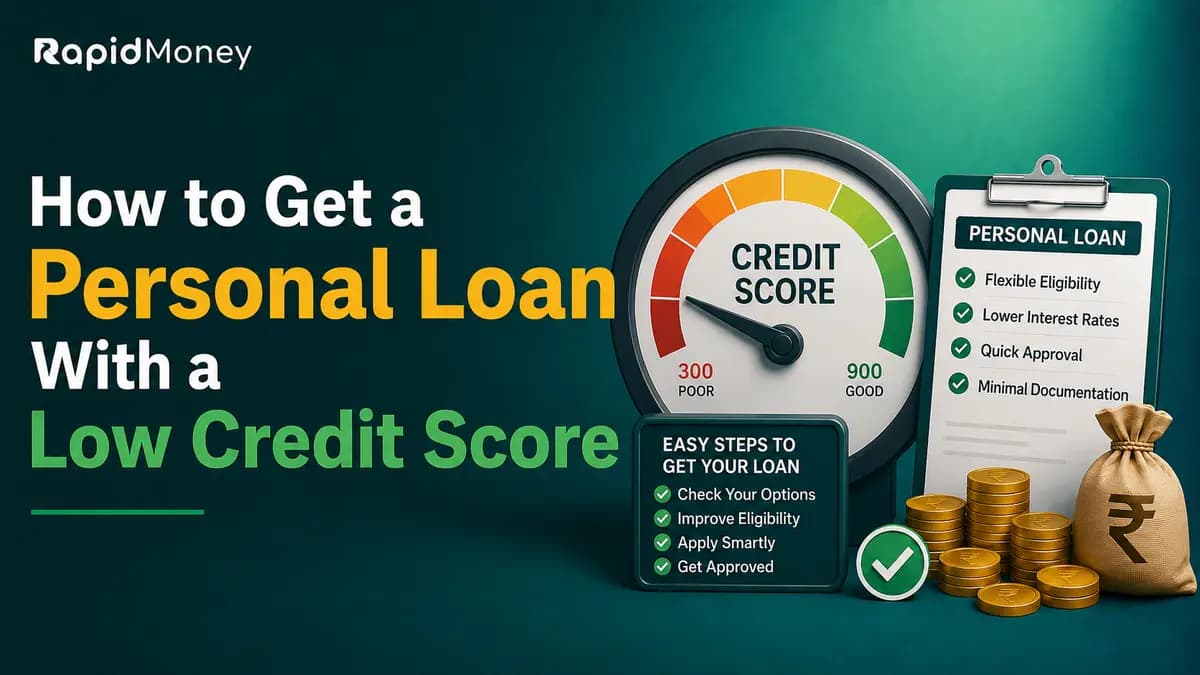
In India, credit scores (most commonly CIBIL scores) range from 300 to 900. Here’s a general breakdown lenders use:
Your credit score advises a lender about your chances of paying on time. It reflects your history with EMIs, credit cards, and past loans.
| Score Range | Rating | Typical Loan Access |
|---|---|---|
| 750–900 | Excellent | Best rates, fastest approval |
| 700–749 | Good | Standard bank approval |
| 650–699 | Fair | Approval possible, higher rate |
| 600–649 | Low/Poor | NBFC or fintech lenders, higher cost |
| Below 600 | Very Poor | Secured loans or co-applicant usually required |
A low score signals higher risk — which is why lenders compensate with higher interest rates, lower loan amounts, or added conditions like a co-applicant.
Understanding this logic helps you approach lenders strategically instead of applying unthinkingly and collecting rejections, which can damage your score further through repeated hard inquiries.
Also Read : How to Improve Cibil Score
Yeah Lenders in 2026 are looking more and more at the complete financial picture and not just your score.
Many NBFCs and fintech platforms now factor in:
This shift has made a personal loan with a low credit score far more accessible than it was even a few years ago — provided you approach the right lenders.
Pull your CIBIL, Experian, or CRIF High Mark report before applying anywhere. Errors are common, and disputing an inaccurate entry can raise your score within weeks.
Your eligibility is calculated on the basis of your FOIR (Fixed Obligation to Income Ratio). If you ask for a modest, reasonable amount, you're much more likely to get it approved.
If you are under 650, stay away from the larger banks first. Get in touch with NBFCs, digital lenders or your existing bank if you have a salary account there.
A co-applicant with a score above 700 can unlock standard interest rates even when your own score is weak.
A loan against a fixed deposit, gold, or other asset removes much of the lender’s risk and often comes with the lowest possible rate for low-score borrowers.
Don’t apply to five lenders individually; each hard inquiry can take points off your score. Use an aggregator portal to compare rates side by side.
Every RBI-regulated lender must present you with a KFS displaying the actual annual percentage rate, including processing fees. Always check it before accepting an offer.
| Loan Type | Typical Score Needed |
|---|---|
| NBFC Personal Loan | 600–650+ |
| Fintech/Digital Lender | 600+ |
| Loan Against Fixed Deposit | No minimum |
| Gold Loan | No minimum |
| Co-Applicant/Guarantor Loan | Depends on co-applicant |
| Credit Union / NBFC-MFI | Varies |
Pro Tip: If you have an existing relationship with a bank (salary account, fixed deposit, or credit card in good standing), start there. Relationship banking often softens strict score cutoffs.
Interest rates for low credit score borrowers are noticeably higher than the headline rates banks advertise for prime customers.
| Credit Score | Approximate Rate Range (p.a.) |
|---|---|
| 750+ | 9.99%–12% |
| 700–749 | 11%–16% |
| 650–699 | 14%–22% |
| Below 650 | 18%–36% |
As of mid-2026, top private banks continue to advertise starting rates near 9.99% for applicants with scores above 750, while borrowers with weaker profiles typically see rates several percentage points higher, along with added processing fees.
Beyond the interest rate, budget for:
| Document Type | Examples |
|---|---|
| Identity Proof | Aadhaar, PAN, Passport, Voter ID |
| Address Proof | Utility bill, rental agreement, Aadhaar |
| Income Proof | Salary slips (last 3 months), Form 16, ITR |
| Bank Statements | Last 6 months |
| Employment Proof | Offer letter or employment certificate |
| Co-Applicant Documents | ID, address, and income proof (if applicable) |
Having these ready before you apply speeds up approval and reduces back-and-forth requests that can delay disbursal.
Also Read : Documents required for Personal Loan
If your need isn’t urgent, spending even 60–90 days improving your score can unlock better terms meaningfully.
These habits can raise a score by 20–50 points within a few months, often enough to shift you into a better pricing bracket.
1. What credit score is considered too low for a personal loan?
Most banks want a score over 700. Anything below 650 is normally deemed low yet NBFCs and fintech lenders may nonetheless approve your application though usually at higher interest rates and with stricter income checks.
2. Can I get a personal loan with a CIBIL score below 600?
It is challenging but not impossible. You can go for secured loans against a fixed deposit or gold or even apply with a creditworthy co-applicant to boost your profile.
3. Do NBFCs approve loans more easily than banks for low credit scores?
Yes. NBFCs and digital lenders have the ability to be more flexible than traditional banks, as they look at alternative data such as your bank statements and income patterns, in addition to your credit score.
4. Will applying for a low-credit personal loan hurt my score further?
A forceful inquiry can create a little momentary decline. This is compounded by applying to multiple lenders in a short space of time, so shop around and apply selectively.
5. Is a co-applicant necessary for a bad credit personal loan?
Not always, but it makes a big difference in your prospects of being approved and can help you get a cheaper interest rate by adding one with a good credit score.
6. What interest rate should I expect with a low credit score?
For people with scores under 650, rates are often 18% to 36% a year, compared with less than 12% for those with great credit.
7. Can a personal loan help rebuild my credit score?
Yes. Paying your EMI on time and regularly for a new loan is a sign of your reliability and can boost your credit score slowly over a few months.
8. Are secured loans better than unsecured ones for low credit scores?
Secured loans (e.g. loans against fixed deposit or gold) are often cheaper and easier to get as the collateral reduces the lender’s risk.
9.How can I improve my chances of getting a personal loan with a low credit score?
Maintain a stable income, repay existing debts on time, and apply only if you meet the lender's eligibility criteria. Providing accurate documents and avoiding multiple loan applications can also improve your approval chances.
Getting a personal loan with a low credit score in 2026 takes more strategy than it used to, but it’s far from impossible.
Focus on the right lender category, keep your loan amount realistic, and consider a co-applicant or collateral if your score is under 650.
Most importantly, treat the loan as a stepping stone: consistent, on-time repayment is one of the fastest ways to rebuild your credit profile for better terms down the road.
Ready to explore your options? Compare offers from multiple lenders, review the Key Fact Statement carefully, and choose the loan that fits your budget — not just the one that approves you fastest.