Wondering how much CIBIL score is required for a personal loan? In most cases, lenders look for a score of 750 or above to approve your application smoothly and offer competitive interest rates. But that's not the whole story — your approval odds, loan amount, and pricing all shift depending on exactly where your score falls.
A CIBIL score is a three-digit number between 300 and 900, generated by TransUnion CIBIL, one of India's four RBI-licensed credit bureaus. It reflects how responsibly you've managed credit in the past, based on your loan and credit card repayment history.
Every time you take a loan or use a credit card, the lender reports your repayment activity to CIBIL. This data gets compiled into your credit report, and the score is calculated from patterns within it — timely payments, missed EMIs, credit usage, and more.
Lenders pull this score whenever you apply for a personal loan CIBIL score requirement check, and it becomes one of the strongest signals they use to decide whether to approve, reject, or price your loan.
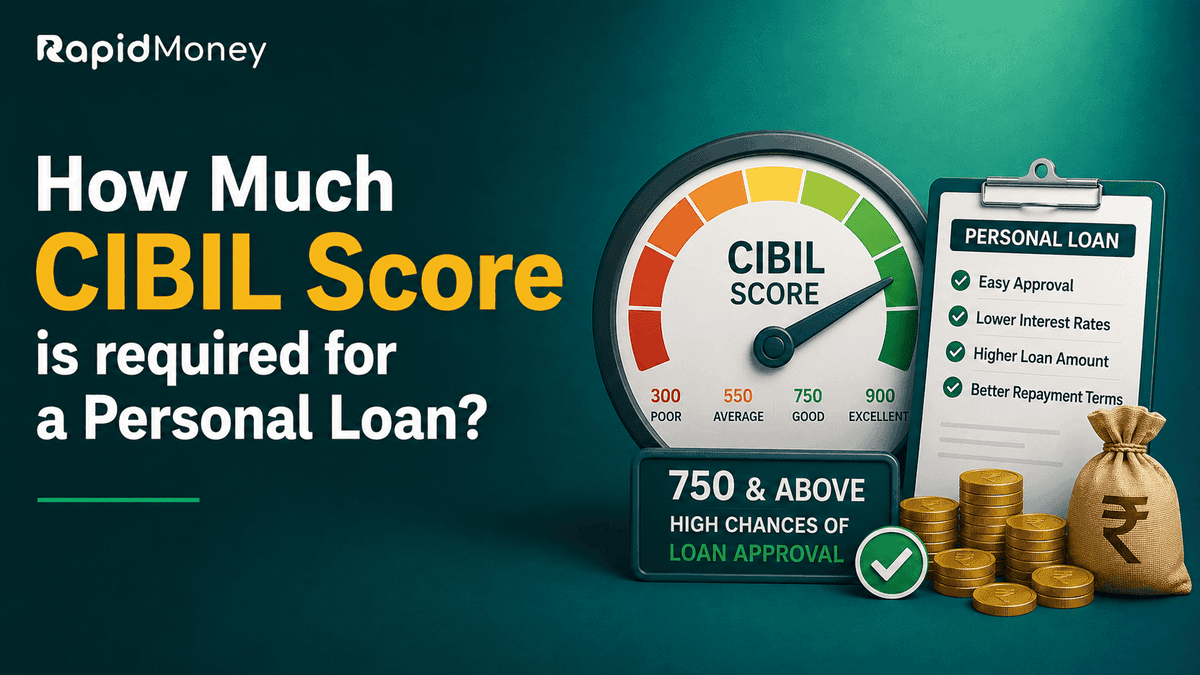
Here's the direct answer: most banks and NBFCs set their minimum credit score for personal loan approval somewhere between 650 and 700, but the ideal CIBIL score for personal loan approval — the one that gets you the best terms — is 750 and above.
It’s much harder to get approved with mainstream banks if your score is below 650. However, some digital lenders and NBFCs may still consider your application with stricter conditions.
| CIBIL Score Range | Approval Likelihood | What to Expect |
|---|---|---|
| 750–900 | Excellent | Fast approval, best interest rates, and higher loan amounts. |
| 700–749 | Good | Approved by most lenders, with slightly higher interest rates possible. |
| 650–699 | Fair | Selective approval, mainly from NBFCs and fintech lenders. |
| 550–649 | Poor | Approval is difficult. Expect higher interest rates and lower loan amounts. |
| Below 550 | Very Poor | Loan rejection is likely with most banks and financial institutions. |
| No Score / NA | New to Credit | Eligibility is assessed based on income, employer profile, and banking relationship. |
A personal loan is unsecured, meaning there's no collateral backing it. If a borrower defaults, the lender has no asset to recover the money from. This makes your credit history the primary tool lenders use to estimate risk.
Your score really only answers one question: How likely are you to pay back on time, based on how you’ve handled credit in the past? Good score gives you confidence. Low scores are a red flag and often lead to rejection or better terms.
Understanding what shapes your score helps you know exactly where to focus your efforts.
Yes — a personal loan without CIBIL score history is possible, though it requires a different approach. If you've never taken a loan or used a credit card, you simply don't have a score yet, which isn't the same as having a poor one.
In such cases, lenders typically evaluate you using:
Building a small credit footprint — like a secured credit card — for a few months before applying can also help establish an initial score.
Your score directly affects the interest rate you receive. The exact rates depend on the lender and the market conditions but the general pattern is:
| CIBIL Score | Indicative Interest Rate Range* |
|---|---|
| 750–900 | Lowest rates offered by the lender |
| 700–749 | Slightly above the lender's best rate |
| 650–699 | Moderately higher rates |
| Below 650 | Highest rates, if approved at all |
*Interest rates are indicative and vary depending on the lender's policies, applicant's income, employment profile, repayment history, loan amount, and other eligibility criteria.
*Actual rates depend on the lender, loan amount, tenure, and applicant's overall profile. Always check current rates directly with the bank or NBFC before applying.
If you have a few months before you need the loan, improving your score first can save you significantly on interest costs.
Even a modest 20–30 point improvement can shift you into a better pricing bracket.
750+ is the ideal standard for the best chances of approval and best interest rates, but lenders generally want to see a score of at least 650-700 to even consider a borrower.
A score of 750+ is considered good.Lenders at this level generally offer quicker approvals, competitive rates and higher loan amounts.
Yes, there will be many lenders and fintech platforms that will offer instant personal loans for applicants with a score of 700. The interest rate would be slightly higher as your score is above 750.
Yes. Applicants with no credit history will be assessed on their income, job stability and banking relationships by lenders. Having a co-applicant can also boost the chances of approval.
No. Checking your own score is a "soft inquiry" and has no impact. Only "hard inquiries," triggered when a lender checks your score for a loan application, can slightly affect it.
CIBIL scores are generally updated on a monthly basis based on the information reported by banks and NBFCs to the bureau.
Meaningful improvement usually takes a few months of consistent, on-time repayments and reduced credit utilisation. There's no legitimate way to boost it overnight.
Yes. Along with income, a higher score often increases the loan amount a lender is willing to sanction, while a lower score may reduce the sanctioned amount.
Scores below 550-600 will make the chances of getting a loan from traditional banks much lower, while some NBFCs may still look at the application, but on a tougher basis.
Often, yes. NBFCs and digital lenders sometimes have more flexible score requirements than traditional banks, though this may come with higher interest rates.
So, what is the CIBIL score needed for a personal loan? There is no universal number, but if you aim for 750 or above, you will have the smoothest path to approval, better interest rates, and higher loan amounts. If you’re not there yet, it’s not the end of the world – better repayment habits, lower credit utilisation or applying with a co-applicant can all help.
Check your CIBIL score, compare offers across a few lenders and review your credit report for errors before you apply. A bit of preparation can go a long way towards getting a personal loan on terms that work for you.