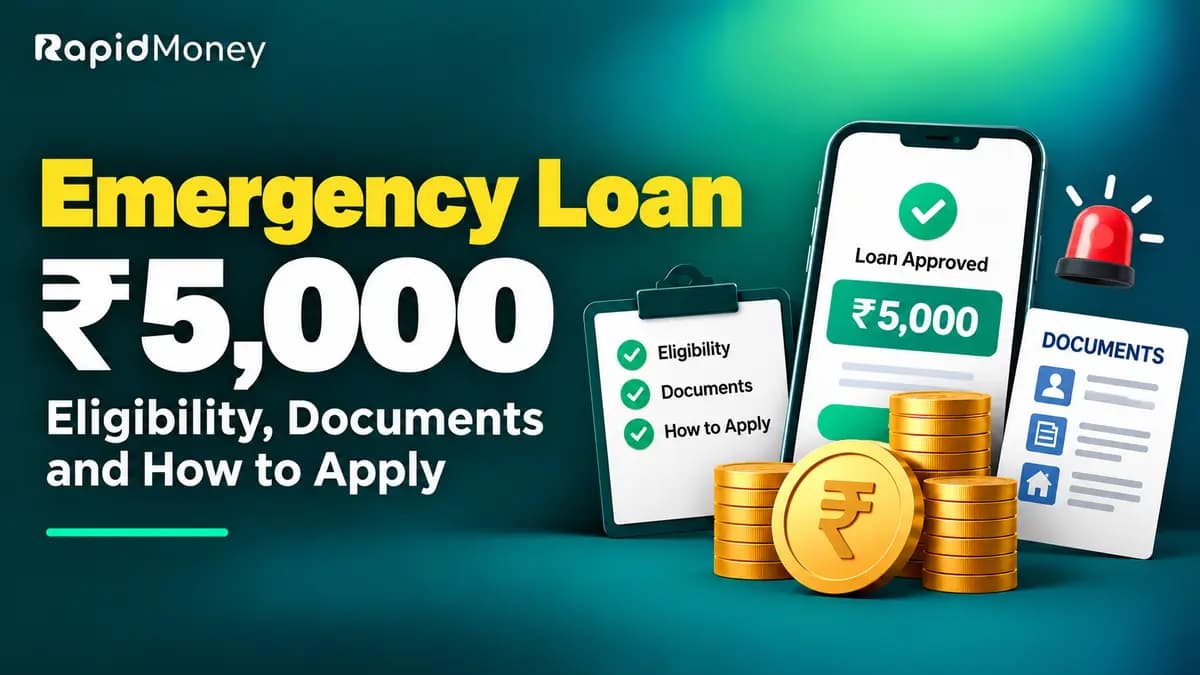
An emergency loan ₹5,000 can help you manage urgent expenses such as medical bills, travel costs, or unexpected repairs. You can apply online through a lender or loan service provider by checking eligibility and submitting the required documents. Before applying, compare interest rates, processing fees, and repayment terms to make an informed borrowing decision.
Unexpected expenses can arise at any time, whether it is a medical bill, a vehicle repair, an urgent household purchase, or a shortfall before payday. When you need a small amount quickly, an emergency loan 5,000 may be one option to consider.
An emergency loan 5,000 is a small borrowing facility that eligible applicants may obtain through a bank, a regulated Non-Banking Financial Company (NBFC), or a digital lending platform working with an authorised lender. The application process may be completed online depending on the lender with the eligibility checks and document verification also carried out online by the lender.
However, approval is not guaranteed, and interest rates, processing fees, repayment periods, and eligibility requirements vary between lenders.
In this guide, you will learn how to apply for a ₹5,000 loan online, the documents you may need, the factors lenders consider, and how to borrow responsibly.
An emergency loan ₹5,000 is a small personal loan intended to help cover an immediate financial requirement. Unlike a traditional loan that may involve a larger borrowing amount, some small-ticket credit products allow eligible borrowers to apply for a relatively modest sum.
An instant emergency loan may be available through a lender's website or mobile application. The lender then makes a decision. The applicant normally gives personal details, verifies their identity and completes a credit check.
Common reasons people consider an urgent loan of ₹5,000 include:
A personal loan should be considered only when the expense is necessary and you have a realistic plan to repay the borrowed amount.
The application process will vary by bank, NBFC or the lending platform you use. These are the processes a normal online application will go through.
Research banks, RBI-regulated NBFCs, and digital lending platforms that clearly identify their lending partners. Verify the actual lender before submitting an application.
Do not assume all loan application sites or mobile apps are directly providing credit. Some platforms allow applications for regulated lenders.
Review the lender's minimum age, income requirements, employment conditions, residency criteria, and credit assessment process.
Some lenders will only accept people with salaries and others may be open to the self-employed. terms apply, therefore make sure you read the exact product terms before you apply.
Enter the requested details, which may include:
Provide accurate information and submit documents only through the lender's verified channels.
The lender could analyse your identity, income, bank account details and credit history. Depending on their criteria it can take additional paperwork or online verification.
Completing these steps does not guarantee approval.
If your application is approved, check the loan amount, annual percentage rate (APR), processing fee, payback schedule, late payment charges applicable and total amount payable.
Read the Key Fact Statement (KFS) and loan agreement before accepting the offer.
Proceed only if you understand and agree to the terms. Once the lender has completed its processes, the approved amount can be transferred to your confirmed bank account.
Disbursement time varies by lender and application. Do not rely on claims of guaranteed approval or guaranteed instant transfers.
There is no single eligibility standard for every emergency loan in India. Each lender establishes its own credit policy and may consider several factors.
| Eligibility Factor | What Lenders May Check |
|---|---|
| Age | Whether you meet the lender's minimum and maximum age requirements |
| Income | Whether your earnings support the proposed repayment |
| Employment | Your employment status, occupation, or business income |
| Credit History | Your repayment record and available credit information |
| Existing Debt | Current EMIs, outstanding loans, and other financial commitments |
| Identity Verification | Whether your personal and KYC details can be verified |
| Bank Account | Whether your account details meet the lender's requirements |
A low CIBIL score may reduce your chances of approval, but the outcome depends on the lender's assessment and other aspects of your financial profile.
Lenders may also evaluate other information like as stability of income, banking activity, current commitments and previous repayment behaviour. Others may require a minimum credit score.
If you have a low credit score, examine your credit report for inaccuracies, pay your existing dues on time and avoid making several applications in a short span. Never pay an unofficial agent who promises guaranteed approval despite a poor credit history.
Possibly, depending on the lender and your income source. A salary slip is not necessarily the only acceptable way to establish income.
Some lenders may accept bank statements, salary credits, tax documents, or other income evidence. Self-employed applicants may be asked for different documents.
However, a loan advertised as available without a salary slip does not necessarily mean a loan without income verification or KYC.
Also Read|How to Get a Personal Loan Without a Salary Slip›
For a ₹5,000 loan online, the documentation requirements may be simpler than those for some larger loans. Nevertheless, lenders must complete the applicable verification procedures.
The following documents or details may be requested:
Not every lender requires every item listed above. Follow the actual lender's checklist, and never share an OTP, PIN, password, or banking credentials with an agent.
The total cost of borrowing depends on the lender's interest rate, repayment term, processing fee, taxes on applicable charges, and other contractual terms.
Before accepting an offer, compare the annual percentage rate (APR) and the total repayment amount rather than looking only at the advertised interest rate.
A short repayment period can make the amount due feel manageable, but it can also create pressure if your next salary or other income is delayed.
Before borrowing, ask yourself:
If repayment would require taking another loan, reconsider whether borrowing is the right choice.
When looking for an emergency loan app in India, safety and transparency are as important as speed.
Use this checklist before applying:
1. Verify the actual lender. Identify the bank/NBFC providing the loan. If the platform is a Lending Service Provider (LSP), check if it is connected to the licensed lender.
2. Check the RBI's digital lending app directory. The Reserve Bank of India provides a directory to help consumers verify digital lending apps associated with regulated entities. Confirm that the app and its lending relationship match the information supplied by the provider.
3. Read the Key Fact Statement. Check the APR, payback timeline, costs, grievance redressal details and other pertinent stipulations before signing.
4. Check permissions and privacy practices. Be cautious if an app demands unnecessary access to your contacts, call logs, or personal files. Provide only information required for the legitimate application and permitted verification process.
5. Avoid upfront-payment scams. Be suspicious of requests to transfer money to a personal account to guarantee loan approval or release funds.
6. Understand the repayment and complaint process. Keep copies of the loan agreement, sanction letter, KFS and payment receipts. Know the contact details of the grievance redressal person of the lender.
Also Read|Top 7 Small Loan Apps in India (2026 Guide)›
Borrowing is not always the cheapest way to handle a temporary financial problem. Depending on your situation, consider these alternatives before applying.
Compare the actual cost and risks of each option. A regulated loan may be suitable in some situations, but it should not be the automatic first choice.
Check suitable small personal loan products offered by banks, regulated NBFCs and their licensed digital lending platforms. Complete the application, provide the needed information, and check the offer if accepted. The time it will take to get approved and paid will vary.
While certain application processes may be almost entirely digital, lenders may still need to know your KYC, identification verification, and income or banking details. Don't think that you can get a loan with no paperwork whatsoever.
Lenders do not all have the same eligibility requirements. Some may look at credit history and bureau information, but others might look at other things. It will rely on the lender’s credit policy and your overall profile.
You may be eligible with some lenders if you meet their income, identity-verification, and credit requirements. They may request bank statements or other evidence of earnings. Check the selected lender's eligibility conditions before applying.
Check lender’s identity, APR, processing costs, total repayment amount, due date, late payment charges, privacy policy and grievance redressal mechanism. Please read the KFS and loan agreement carefully before you accept.
An emergency loan 5,000 can help cover a necessary expense when other funds are unavailable, but the right borrowing decision depends on your ability to repay and the total cost of credit.
So, before you apply for an urgent loan for 5,000, be sure to compare the various lenders. Check your eligibility, get the necessary documents, and make sure that the lender is regulated. Be sure to review all charges and repayment terms before accepting any offer.
Need ₹5,000 for an emergency? Explore RapidMoney to check your loan options and take the next step toward meeting your urgent financial needs.